
Case study
Detecting the unknown.
Electron diffraction completed the structural picture of a solid-state reaction – confirming what was happening inside a tablet.
The study
A reaction happening inside a tablet.
The Centre for Continuous Manufacturing and Advanced Crystallisation (CMAC), with the University of Strathclyde and others, used a non-destructive technique – X-ray diffraction computed tomography (XRD-CT) – to study solid-state chemical reactions inside tablets, building a full picture of the reactions taking place.
Complementing that work with electron diffraction, the structure of the solid-state reaction product was fully elucidated – giving direct proof of the proposed chemistry.
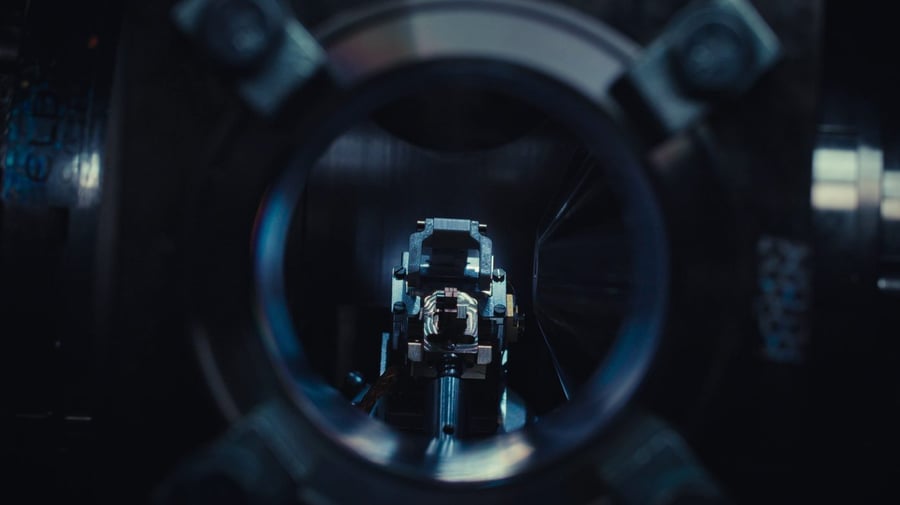
What electron diffraction contributed
The complementary technique that closed the case.
Structure from nano-crystals
Straightforward structural information from nanocrystalline material – no large single crystal required.
A complementary technique
ED sat alongside XRD-CT to confirm and complete the solid-state picture, not replace it.
Impurities & phases resolved
Impurities, side-products and different polymorphic phases can be characterised directly by ED.
Download the paper if you want to see
How ED closed the loop.
- How electron-diffraction experiments contributed to the study.
- How ED obtains structural information from nano-crystals.
- Why ED matters as a complementary technique.
- How impurities, side-products and polymorphic phases are characterised by ED.

Download the published paper.
See how electron diffraction elucidated the structure of a solid-state reaction product and confirmed the chemistry inside the tablet.
After submitting the form, you'll receive an email with a link to download the paper.